
- October 26, 2021
- Posted by: cwadadmins
- Category: Fourth Quarter
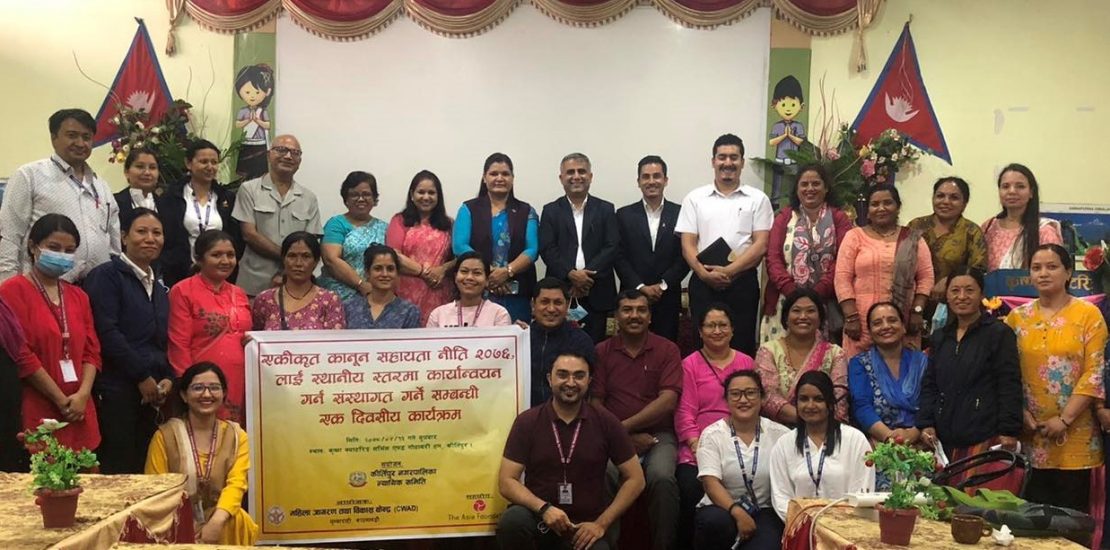
CWAD in coordination with Judicial Committee of Kirtipur Municipality, organized a One Day Program on 28th July 2021 (Shrawan 13th, 2078). Judicial Committee Members, Mediation Committee Members, Ward Members, Executive Members, Paralegals, as well as Legal, Finance, Women and administrative officials of Kirtipur Municipality shown their active participation.
A total of 35 people participated among which 9 were male and 26 were female. Deputy Mayor (DM) Saraswoti Khadka, Chief Administrative Officer (CAO) Krishna Prasad Sapkota, Judicial committee member Milan Maharjan and Judicial committee secretariat Safala Karki also attended the program.
The objective of the program was to aware about the existence and need for localization of Legal Aid Policy, 2076 among the Judicial Committee Members, Mediation Committee Members, Ward Members, Executive Members, Paralegals, as well as Legal, Finance, Women and administrative officials of Kirtipur Municipality. Total 15 provisions in this policy provides a guideline to improve free legal aid services to poor, marginalized and disadvantage group. Similarly, Previously District Women Development office and now Women Development office in each municipality need to be strengthened with sufficient fund to localize and exercise the Legal Aid Policy, 2076 at local level to enhance access to justice of poor, marginalized and disadvantage group of their respective Municipalities.
During these meetings, Prof. Dr. Shashi Adhikary presented her paper on “Localization of Legal Aid Policy 2076 at local level”. She started her session to have a common understanding about the word “Legal Aid”. With few commendable attempts from the participants, she elaborated with the history of legal aid and its policies in Nepal. In doing so, she added that after the Legal Aid Act, 2054 was enacted, the right to equal justice and legal aid was guaranteed for those unable to protect their legal rights due to financial and social reasons. However, this act was unable to address the voices of marginalized and disadvantages groups. Later after series of advocacy meetings and dialogues with concerned ministries the Legal Aid Policy, 2076 was enacted where the voices of marginalized, people with disability, disadvantages were addressed.
To recall the first ever free legal aid practice in the context of Nepal dated back to 2015 B.S (1958 A.D) as a provision of stipendiary lawyer in the Supreme Court. Then after the establishment of Nepal Bar Association in 1997 A.D., has been providing free legal aid service in various districts of Nepal. In the same way, Legal Aid Act 2054 ensured free legal aid service and appointed lawyers by forming a district legal aid committee in each district of Nepal from 2066 Ashoj 1st, in all districts of Nepal. She added that the Constitution of Nepal 2015, guarantees 31 fundamental rights, where free legal aid service is one relating to justice.
In the similar manner, she mentioned and illustrated those act that ensure the free legal aid service are: Senior Citizen Act, 2063; Domestic Violence (Offence and Punishment) Act, 2066; The Act Relating to Rights of Persons with Disabilities, 2074; Human Trafficking and Transportation (Control) Act, 2064 and Sexual Violence related acts. Likewise, she mentioned the names of Governmental and non-governmental bodies providing free legal aid services are: National Women Commission (NWC); Ministry of Women, Children and Senior Citizen (MoWCSC); Governmental mechanism (District Legal Aid Committee); Nepal Bar Association and other Non-Governmental Organizations (LACC).
Lastly, she highlighted roles to be performed by the local level government for the localization of the Legal Aid Policy, 2076 at local level. As legal aid policy is to provide free legal aid services to needy people unable to afford a lawyer regardless of the nature of case. Moreover, they must keep in consideration to provide psychosocial counselling, safe house, expenses for medical treatment of the needy people as per the need. Likewise, organize awareness campaign regarding the free legal aid service, establishment of GBV fund as well as mobilize the paralegals, mediators, social mobilizer, volunteer, as well as students from faculty of law in this process.
Dr. Anita Shrestha, CWAD chairperson concluded the program by her concluding remarks. She thanked judicial committee member of Kritipur Municipality. And appreciate the commitment from Deputy Mayor and Chief Administrative Office from their respective position for their municipality. Lastly, again thanked DM, CAO, judicial committee members, executive members, mediators, and government officials for the active participation.